Highport
| Region | The East, eastern coast |
| Type | Port City — occupied |
| Former Government | Cinque Stelle Pirates + neighborhood autonomy |
| Current Occupier | The Slavelords (since winter 4724) |
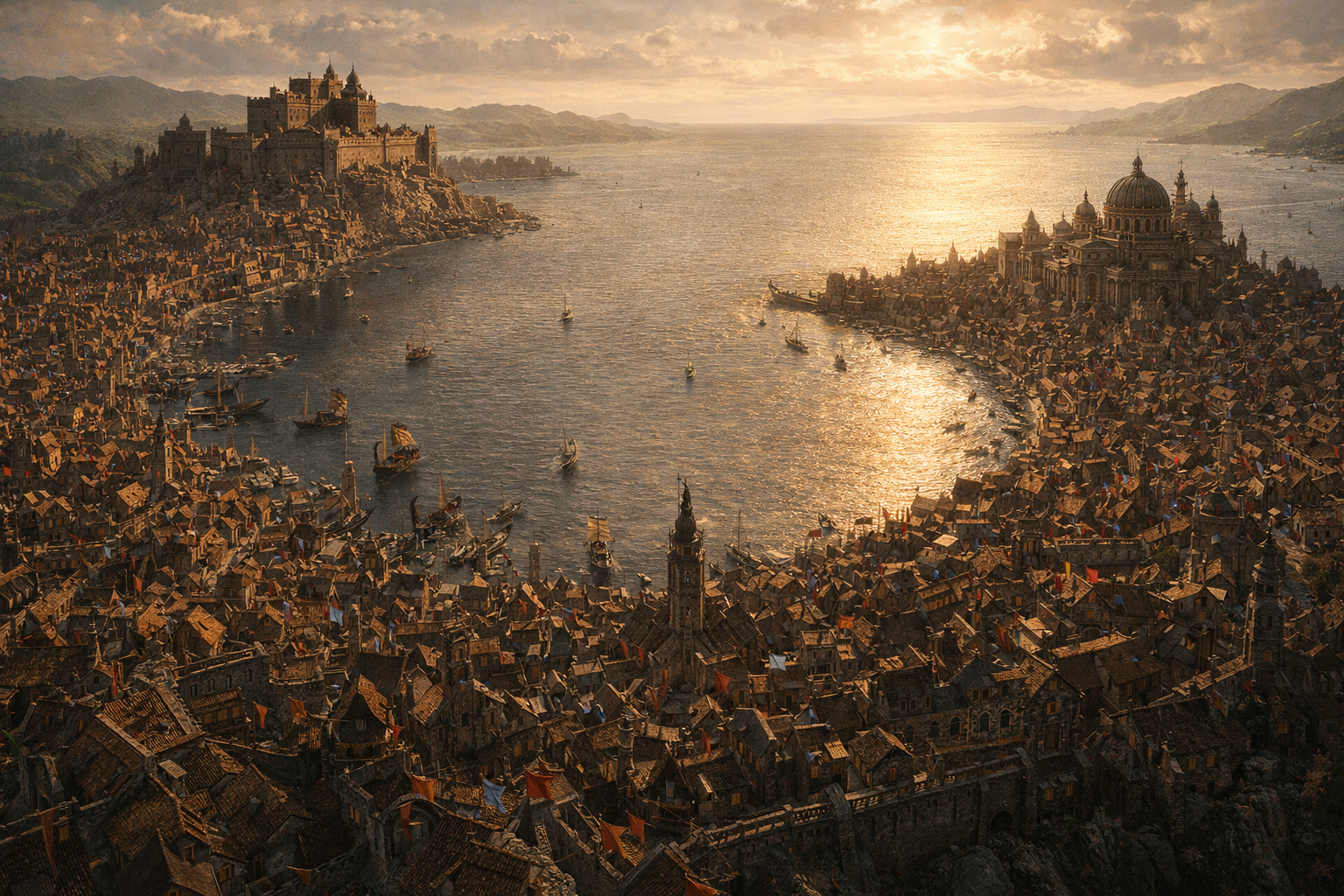
| Shape | Bean-shaped along a rounded coastal bay, oriented north to south |
 |
What It Was
Highport was built by people who had decided, each for their own reasons, that they were done paying taxes to someone else's empire.
Its founders came from three directions: dwarven explorers pushing south from the League's coastal cities, imperial settlers moving east from the Ulek heartland, and representatives of the Five Royal Families of Terenei who needed sea access and found that neither the League nor the Empire was especially interested in providing it on acceptable terms. The three currents collided on a curved eastern bay and produced something none of them had planned: a city that belonged to all of them equally, which meant it belonged to no one.
The result was the most diverse settlement on Ardentis. Every race, every faith, every trade, every vice — represented somewhere in the city, usually within three streets of something that would have horrified it. A dwarven ironmonger operating next to a Terenei silk house next to a temple to a god neither of their neighbors recognized. It worked, barely, because everyone had agreed — implicitly, grudgingly, practically — that the alternative was a fight no one could win.
Shape and Landmarks
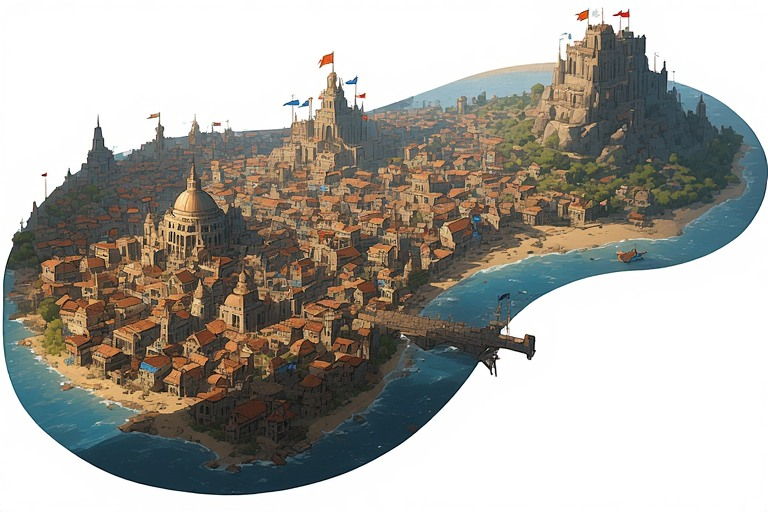
Viewed from the water or from height, Highport traces a bean shape along the coast — a long, rounded outline following the curve of the bay, wider in the middle, pinching toward two distinct ends. The entire curve faces water. Every neighborhood has some access to the harbor; this was a founding principle, embedded in the city's earliest agreements.
 At the two far points of the bean stand the city's defining structures:
High Fort (North End)
A massive walled fortress built on a raised rock plateau — approximately 400 by 250 feet of stone walls, towers, and fortified interior. The High Fort was never owned by any single faction; it was maintained collectively by the Cinque Stelle as a shared military asset, its garrison drawn from across the city's communities. It dominated the northern approach and gave Highport's defenders a commanding position over any fleet attempting entry from that direction.
It is now the Slavelord command center. The flags of the Cinque Stelle no longer fly from its towers.
Temple of All Gods (South End)
At the southern tip of the bean, the Temple of All Gods was Highport's most ambitious and most argued-over institution — a single large temple designed to house worship for every deity recognized in the city. Not in separate wings or competing annexes, but in a genuinely shared space, organized by a rotating council of clergy from all represented faiths.
It worked imperfectly and constantly. The clergy argued about precedence, about altar placement, about which holy days took priority in the shared calendar. But it was also the most visited building in Highport. People came not just to worship but to look — at the others, at the strangeness of it, at the experiment of shared sacred space actually being attempted.
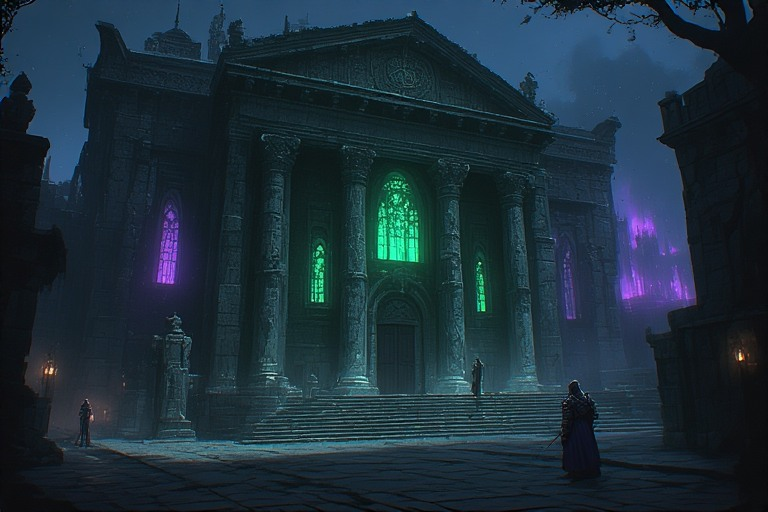
It is now a dark laboratory operated by one of the Slavelord masters. What exactly is being produced or conducted inside is not fully known. The clergy who were not killed fled. The doors are guarded.
The Cinque Stelle Pirates
The Cinque Stelle — the Five Stars — were the closest thing Highport had to a government, and they were careful not to be mistaken for one.
Five former admirals: two from the League of Dwarven Trade Cities, two from the Ulek imperial navy, one from a Terenei-affiliated fleet. All five had, at different points in their careers, decided that the institution they served had stopped being worth serving. They pooled their ships, their crews, and their reputations, sailed into the bay that would become Highport, and announced that they were open for business under no flag but their own.
Their authority in Highport was real but deliberately limited. They maintained the shared fleet that defended the harbor, mediated disputes between neighborhoods when those disputes threatened the whole city, and enforced the few non-negotiable rules: no blocking harbor access, no attacking ships under Highport's informal protection, no burning each other's buildings down. Everything else was the city's business, not theirs.
The Five Stars are gone now. Two died defending the harbor during the slavelord assault. Two disappeared in the chaos of the fall and have not been found. The fifth surrendered the High Fort under circumstances that no one who witnessed it has reported publicly.
Their flags — five silver stars on black — still hang in a few windows in the occupied city. It is technically illegal under slavelord rule to display them. They keep appearing anyway.
The Neighborhoods
Highport's internal geography was never planned. It accreted. Neighborhoods formed around shared origin, shared faith, shared trade, or simply shared suspicion of everyone outside. Gang territories overlapped with community boundaries. A block could be simultaneously a religious enclave, a criminal territory, and a craft district, depending on which layer you were looking at.
Notable districts included:
- The Dwarven Quay — the northern harbor district, dense with ironworking, shipbuilding, and Dwarfather shrines. The most fortified neighborhood after the High Fort, and the last to fall during the occupation.
- The Silk Mile — the Terenei-influenced commercial district, running the middle curve of the bean. Markets, textile trade, the city's best restaurants. Neutral ground by long custom.
- The Hollow — the inner curve of the bean, lowest elevation, most crowded. Where the poorest and most recently arrived ended up. Also where the best information could be bought, if you knew where to look.
- The Altar Row — the southern approach to the Temple of All Gods, lined with smaller shrines and clergy houses. Before the fall, always busy. Now quiet.
- The Smoke Quarter — the district where Highport's drug trade was most openly conducted. Not hidden — regulated, in the Highport fashion, which meant loosely and after the fact.
The Smoke — Highport's Vice and Its Weaponization
Highport had always had a relationship with intoxicants. The city's founders came from traditions that ranged from dwarven ale culture to Terenei ceremonial herbalism to imperial apothecary guilds, and the combination produced a city with an extraordinarily sophisticated appetite for substances and an equally sophisticated supply chain.
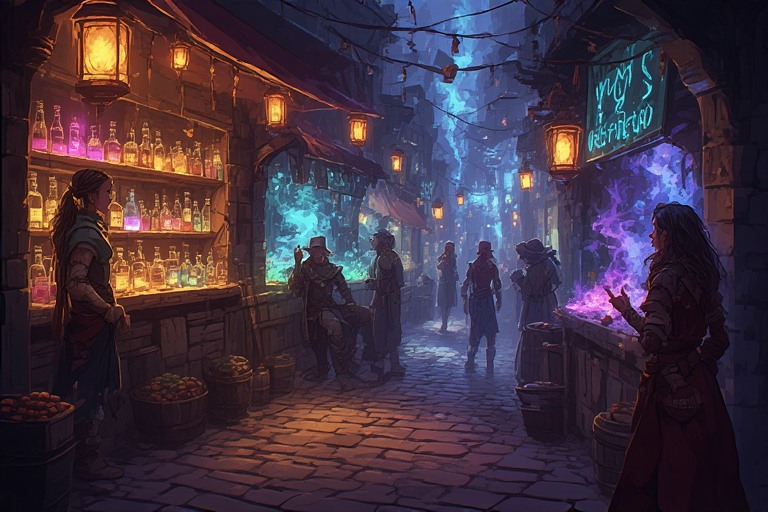 The Smoke Quarter's products were not simple herbs. Highport's alchemists and hedge-mages had spent generations magically enhancing common herbals — extending their effects, intensifying their qualities, binding them to specific sensory experiences. A tincture that made colors brighter. A smoked blend that dissolved social anxiety for an evening. A dreamstone — a resin pressed into a small tablet — that produced six hours of vivid, navigable hallucination. All of it legal, all of it sold openly, all of it woven into the city's social fabric.
Iceflame understood this before the slavelords arrived.
In the years preceding the assault, Iceflame agents introduced modified substances into Highport's supply chains — enhanced versions with deliberately engineered dependency profiles. The modifications were subtle enough that suppliers didn't notice and users couldn't tell. The result was a slow-building addiction epidemic that ran through the city's population for nearly a decade before anyone identified it as coordinated.
By winter 4724, a significant portion of Highport's fighting population was compromised. The Cinque Stelle's garrison was understaffed, undertrained, and in several cases personally affected. The sabotage of the High Fort's defensive mechanisms that preceded the slavelord assault was conducted, in part, by addicted insiders who didn't understand what they were agreeing to.
The city fell in three days. The epidemic was the real siege.
The Slavelords
The islands east of Ardentis were used for centuries as exile destinations — where both the Ulek Empire and the Eastern Kingdoms sent those they considered too dangerous or too criminal for ordinary imprisonment. Over generations, a population of exiles, their descendants, and those who chose to join them formed something resembling a society — organized around survival, distrust, and the skills that got people exiled in the first place.
With resources and coordination provided by Iceflame, this population mounted the assault on Highport. The Slavelords are not a unified organization — they are approximately ten high-ranking individuals, each commanding between 100 and 400 followers, each with a distinct character, specialty, and motivation. They cooperate when it serves them and compete when it doesn't.
See The Slavelords for full narrative profiles and Slavelord Encounter Stat Blocks for PF2e mechanics.
Malvek the Grand Collar (Creature 14) commands from the High Fort. Nyrixa the Pain Alchemist (Creature 12) operates the dark laboratory in the Temple of All Gods. The remaining eight hold operational zones across the city's districts.
Current State (4724–4725)
Highport under occupation is quieter than Highport free. That is the most damning thing about it.
The harbor still operates — the slavelords need it to. Ships move in and out under new flags. The Smoke Quarter is open, now supplying dependency rather than pleasure, the modified substances distributed rather than sold. The neighborhoods have gone inward — doors closed, windows shuttered, the gang territories now serving as the only structure protecting people from something worse.
The Temple of All Gods is lit at night from inside, flickering in colors that the old clergy would not recognize. No one goes near the south end after dark voluntarily.
Somewhere in the Dwarven Quay, someone is still flying a five-star flag. It has been taken down twice. It keeps going back up.
Connections
- The East
- Free Cities of Ulek — Highport was a member; seat now unresolved under occupation
- Nordwall — attacked by slavelord force from occupied Highport
- Iceflame — enabled the takeover through addiction campaign and sabotage
- Terenei — Five Royal Families historically connected to Highport's founding
- The Slavelords — current occupiers
- Ember Testament — Highport is "Islandgate" in cult framing