Ulex City
| Region | The South |
| Type | Major City — administrative capital |
| Population | 15,000–17,000 (walled city); ~50,000 including surrounding settlements |
| Government | Committee of Committees |
| Status | Functioning but stagnant; legitimacy eroding |
The City
Ulex City does not rise — it spreads. Where Hodoronk builds upward and inward, Ulex City extends outward across the southern plain in the classic imperial model: a walled central town at the core, surrounded by farmland, loyal villages, dependent townships, and the slow sprawl of communities that grew up in the empire's administrative shadow.
The Central Town is walled twice. The outer wall encompasses the administrative districts, the grand temple of the Keymaster, the market quarters, and the homes of the merchant class. The inner ring — older, thicker, built when the empire was still confident — holds the great castle, the Lord Mayor's garrison, the Registry, and the noble estates. Between the two rings, the streets are formal, wide, and lined with the kind of architecture that was designed to impress: long colonnaded facades, public fountains that still run, plazas wide enough to muster armies in.
The further you move from the inner ring, the less the city resembles its own ambition. The market quarters are dense and loud and genuinely alive in ways the grand plazas are not. Streets narrow. Buildings crowd. Vendors overflow onto thoroughfares designed for processions. The people here are not particularly unhappy — but they are watchful in the way people become watchful when they have learned that the institutions above them work better for someone else.
Beyond the outer walls: farmland, orchards, the cluster of villages that have been loyal to Ulex City since before the empire fell. These communities are woven into the city's administrative fabric — registered, taxed, and counted. They provide the food and labor that the city's committees depend on, and they receive in return the protections and services that the bureaucracy can still, when functioning correctly, deliver.
The Committee of Committees
When the Ulek Empire collapsed and the crown passed to no one, Ulex City did not collapse with it. Its bureaucratic institutions — layered, interlocked, and exhaustively documented over four thousand years of imperial administration — simply kept running. No single person seized power. A committee was convened to manage the transition. Then a committee to oversee the first committee. Then committees for the committees' committees.
This is not entirely a joke. The Committee of Committees is the city's genuine governing structure — a nested hierarchy of administrative bodies, each responsible for a domain, each reporting upward through layers of review, each staffed by a combination of noble representatives, senior clerics of the Keymaster, and appointed civil administrators. Major decisions require consensus across multiple relevant committees. Minor decisions require documentation, review, and a formal record entry.
The system works. That is the maddening thing. Contracts are enforced. Infrastructure is maintained. Taxes are collected accurately. Disputes are adjudicated by procedures that have been refined for centuries. Services are delivered, slowly, to those the system recognizes.
The problem is what the system has become in the hands of those who run it. The noble class — old imperial families with documented lineage — holds the committee seats. They do not need to steal. They simply use the system as designed, for their own benefit, while the Keymaster's doctrine tells everyone else to accept their place.
The Living Ledgers
The technological marvel of Ulex City — the thing that should not be possible without something that does not exist in this world — is the Registry of Living Ledgers.
The Registry is a vast stone building in the inner ring, staffed entirely by clerics of the Keymaster. Inside, on long stone shelves in climate-controlled vaults, sit hundreds of enchanted tomes — each one responsible for a domain of civic record. Birth registrations. Death records. Property ownership. Contracts. Tax assessments. Guild memberships. Criminal records. Citizenship status.
These tomes update in real time. When a child is born in a village twelve miles from the city walls and a local registrar speaks the binding words over their name, the relevant entry appears simultaneously in the corresponding tome in the Registry vault. When a property changes hands and both parties press their citizenship seals to the transfer document, the Registry records it before the ink dries on the copy.
Clerics carry field tomes — smaller, linked volumes — when they travel to the surrounding settlements. These sync with the central Registry when brought within range of the city's anchor stones. The system was designed by Keymaster theologians who argued, correctly, that a city cannot be governed well without knowing what it contains.
The practical effect is that Ulex City knows its population with extraordinary precision. It knows who owns what, who owes what, who has rights and who does not. It knows things about its citizens that its citizens sometimes do not know about themselves.
Citizenship and the Hierarchy of Documentation
Every person in Ulex City and its surrounding territories holds one of four civic classifications, each documented in the Living Ledgers:
- Noble Citizens — documented imperial lineage, full civic rights, committee eligibility, land ownership rights. The committee seats belong to them by precedent and by law.
- Free Citizens — registered residents with full civic rights: contract enforcement, property ownership, access to city services, legal standing in disputes. The majority of the walled city's population.
- Residents — documented but without full civic standing. Can work, can rent, cannot own property or bring suit without a citizen sponsor. Many of the surrounding villages hold this status despite having lived there for generations.
- The Undocumented — no entry in the Living Ledgers, no legal existence in Ulex City. Cannot own property. Cannot enter formal contracts. Cannot access city services. Cannot be employed by any registered guild or business. They exist in the physical city but not in its administrative reality.
 The Keymaster's doctrine provides the theological foundation for this structure. His teachings on civilization and order include the concept that **each person has a role and a place** — that society functions when individuals understand their position and contribute within it rather than straining against it. In the hands of the noble class, this teaching has calcified into a justification for keeping the hierarchy exactly as it is. The committees debate many things. The classification system is not one of them.
The undocumented population — larger than the city's official records admit, for obvious reasons — lives in the outer market districts and the spaces between. They participate in the informal economy that the formal system pretends does not exist and quietly depends on.
The Keymaster's Temple
The Grand Temple of the Keymaster in the central plaza is the most impressive building in Ulex City that is not the Registry, and the two buildings are connected by a covered walkway that the senior clergy use constantly. The temple is also an archive, also a law school, also an administrative training center. Young clerics spend as much time learning record-keeping and civic procedure as they do studying doctrine — because in Ulex City, these are the same thing.
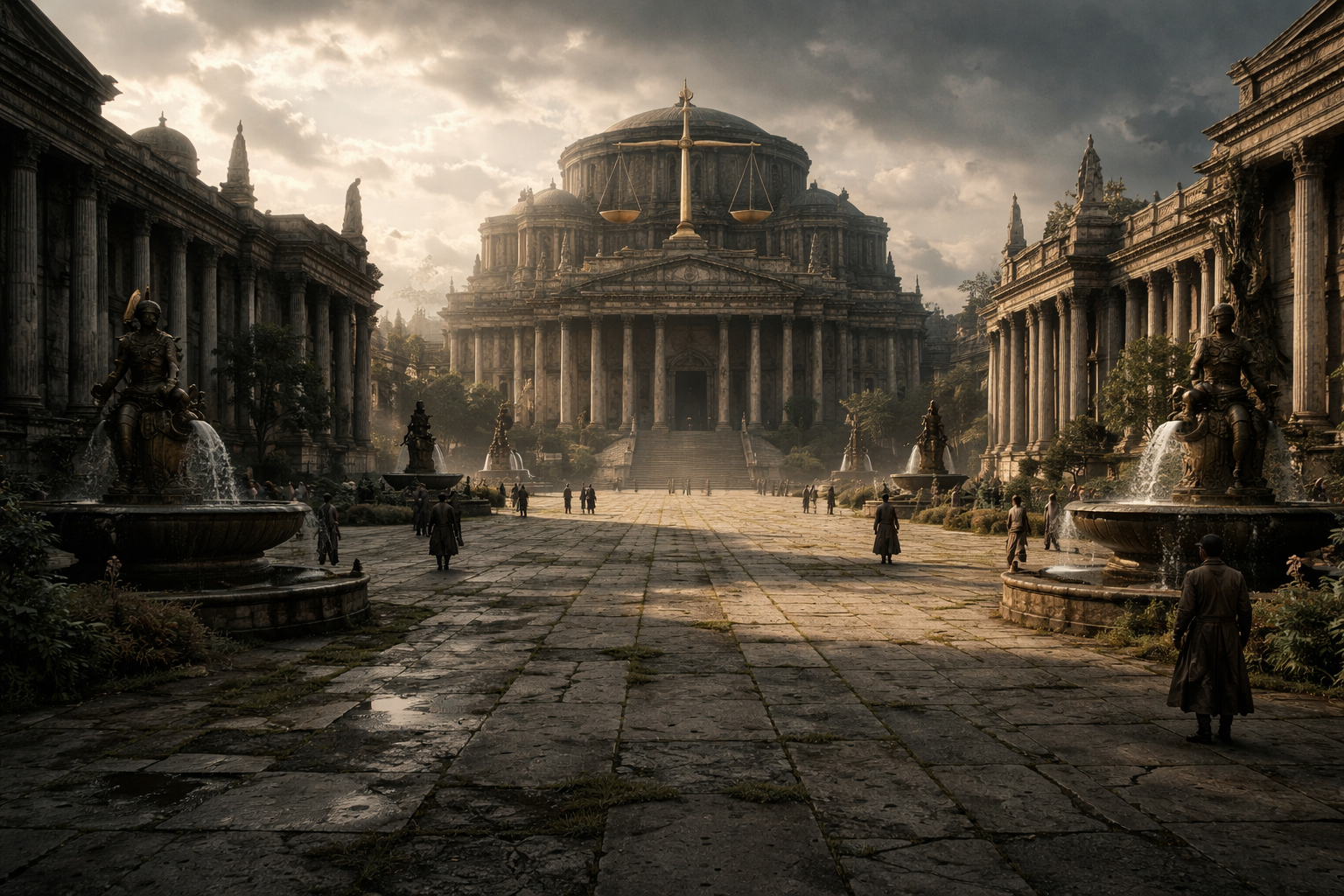 The temple's public face is dignified and austere. The clergy perform their rites, offer guidance, maintain the Ledgers. They are genuinely good at what they do. Whether what they do serves the city's population equitably is a question they are trained to answer with great care and at great length and ultimately in a way that changes nothing.
Lady Annabelle served as High Priestess here for fifty years after Prince Eltram was sealed. Her presence stabilized the city through the worst of the imperial collapse. Her death in ~4554 AR is remembered as the moment the last real anchor let go — after her, the committees drifted, and no one who has held the High Priesthood since has carried the same weight.
Life in the Outer Districts
Past the formal plazas and colonnaded walks of the administrative center, the city lives differently. The market districts generate most of Ulex City's actual commerce — informal, loud, and operating according to social rules that predate the committee system and will outlast it.
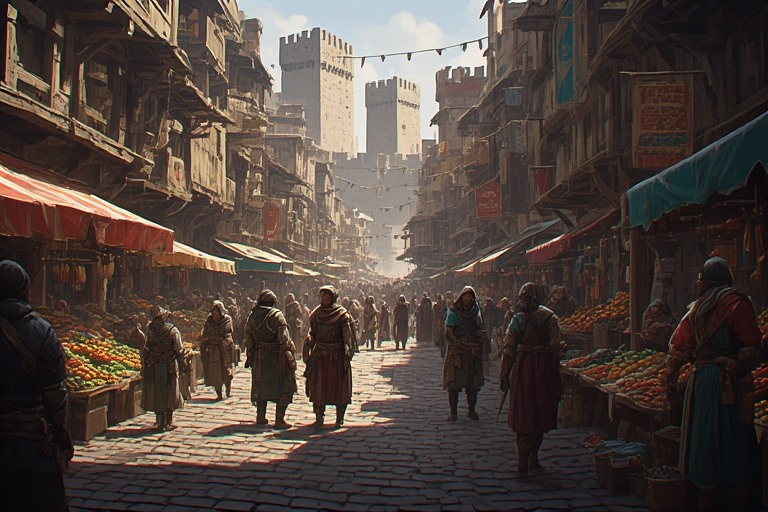 Here you find:
- The Surplus Markets — stalls selling everything the agricultural hinterland produces in excess, plus goods that arrive by southern road from Tower Port and Merchant Port
- The Unlicensed Quarter — a district that officially does not exist, where undocumented residents run businesses, resolve disputes through their own mechanisms, and pay a quiet informal tax to the noble families who choose not to see them
- The Memorial Walks — long avenues lined with carved commemorations of the old imperial era, maintained by a committee, visited by residents who feel the past more vividly than the present
- The Road Inns — large, well-run establishments catering to the trade traffic that still flows through the south, one of the city's most reliable revenue sources
Current State (4724–4725)
Ulex City is not in crisis. That is both its strength and its trap.
The committees are meeting. The Ledgers are updating. The taxes are being collected. From the inner ring's perspective, the city is functioning as designed. The Great Divide is a northern problem. Dark orcs staging through Lighthouse Island are a concern for the coastal cities. The committee on external threats has been convened and has produced a report.
The resentment in the outer districts is at a level the committees have not yet found it necessary to formally acknowledge. The undocumented population has grown over the last two decades in ways the Ledgers, by definition, do not record. Three outer villages quietly stopped remitting their full tax assessments eighteen months ago. A committee has been formed to investigate.
The Keymaster's clergy know — the ones who travel, who use the field tomes, who speak to people outside the inner ring — that the city is carrying more weight than the official records show. They file accurate reports. The reports enter the Ledgers. The committees table them for review.
Connections
- The South
- Prince Eltram Landing — capital of the Kingdom of Ulek faction
- Sandstone — Theodor Crane's usurper empire
- Nordwall — recently declared independence from the Free Cities network
- The Keymaster — civic and spiritual foundation
- Master Timeline — Free Cities Treaty 4648 AR, Lady Annabelle ~4554 AR