 # Hodoronk
| Region | The North, on River Bonk |
| Type | Metropolis — League of Dwarven Trade Cities |
| Population | 25,000–30,000 |
| Government | Council of Guild Masters |
| Encounter Level | 12–16 |
The City
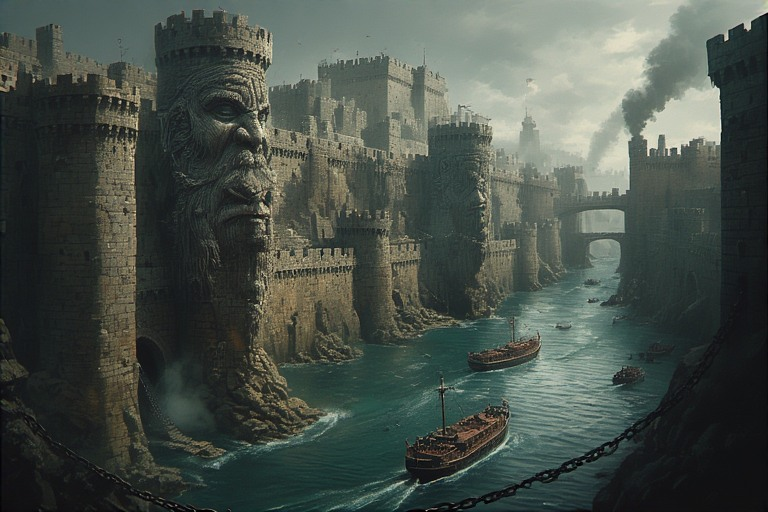
Hodoronk does not announce itself. It accumulates. Travelers approaching from the south first encounter the outer ring of advanced posts — small stone forts positioned a half-day's march from the main walls, each manned, each connected to the next by sight-line. Then the walls themselves: not one curtain but three, each higher than the last, the outermost worn smooth by centuries of weather, the innermost carved with the faces of the Dwarfather in his many aspects. Then the city.
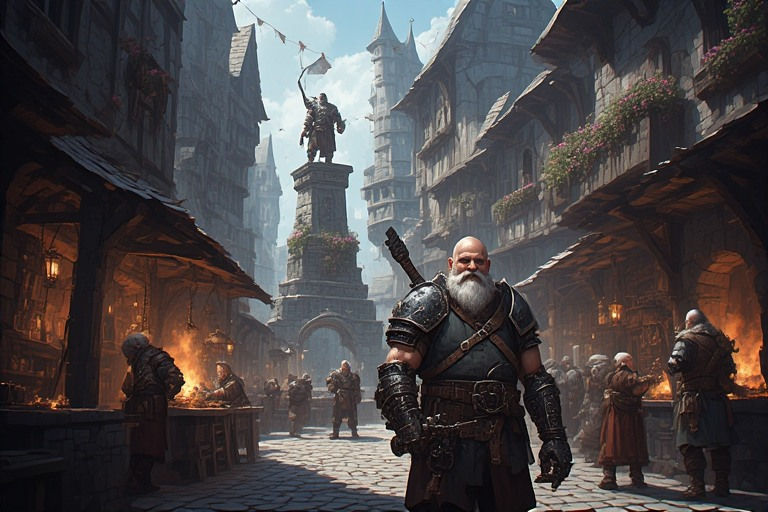
From the inside, Hodoronk is loud, dense, and perpetually in motion. The hammering never stops — not at noon, not at midnight — because somewhere in a city of 30,000 dwarves, someone is always building something, fixing something, or improving something that didn't need improving but could be better. The air smells of forge smoke and river water, a combination so specific to this place that dwarves who have lived elsewhere for decades still recognize it instantly.
The city is built on four levels:
- The Heights — towers, guild halls, the great bridges spanning the canal network, the upper merchant districts. The best views of the river.
- The Stone Streets — the main city. Markets, workshops, temples, residences. The loudest and most crowded layer.
- The Canal Tier — where the River Bonk's water has been channeled into the city's own veins. Warehouses line the banks. Cargo barges move with surprising speed through channels that the dwarves have been widening and deepening for eight centuries.
- The Deep — below street level, carved into the bedrock. The oldest districts are here, pre-dating the upper city. The great forges burn here. And the Deep Lines run here.
The River and Its Defenses
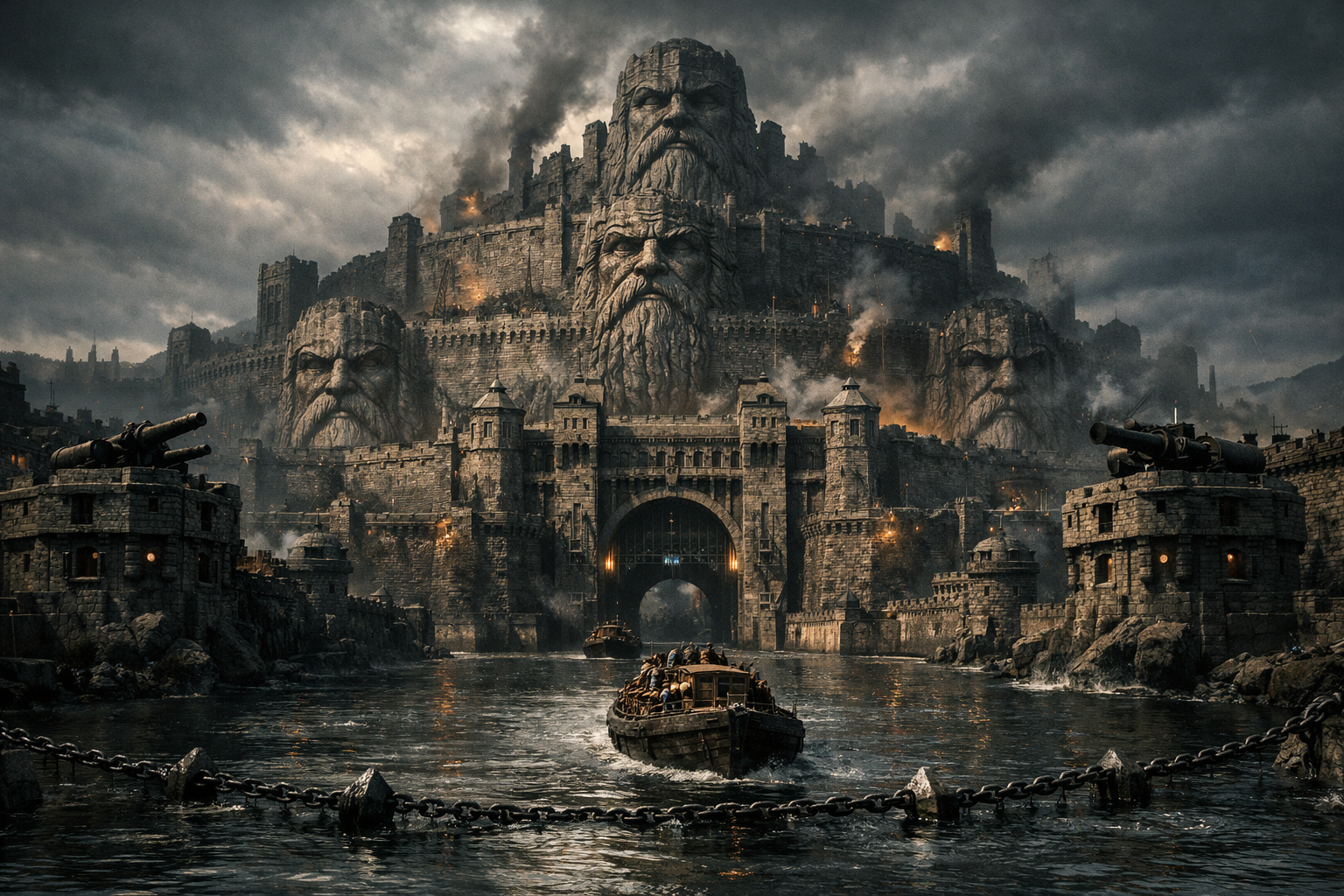 River Bonk is not just Hodoronk's border — it is part of the city's body. The dwarves did not build beside the river; they built *with* it. Canal gates control water flow through the city's lower tier. The port districts handle more cargo tonnage than some coastal cities. Flat-bottomed barges carry goods north toward Tronk and south toward the Krem Hills routes.
The river approach is also the most heavily defended point in the League's territory. Submerged chain barriers can be raised to stop vessels mid-river. Stone gun towers — squat, thick-walled, low-profile — line both banks with overlapping fields of fire. Booms of treated timber, reinforced with iron brackets, can seal the main channel in under ten minutes if the river bell is rung.
No enemy has successfully forced the river approach in recorded history. Hodoronk's military strategists are proud of this in the particular way dwarves are proud of things: they do not boast about it; they just keep improving the defenses anyway.
The Dwarfather's Presence
The Dwarfather is not worshipped in Hodoronk so much as lived. There is no separation between the religious and the civic here — the two are the same thing, expressed in stone.
Statues of the Dwarfather appear on every major street corner, in every guild hall entrance, above every forge door. He is depicted in different aspects depending on location: the Miner in the deep districts, the Builder on the Heights, the Engineer near the transit stations, the Warrior on the outer walls. No two statues are identical. Each was made by the priest who placed it, and each reflects that priest's particular understanding of the god.
Dwarfather priests are required to be craftspeople first. Theological knowledge matters, but a priest who cannot demonstrate genuine mastery of a craft — stonecutting, ironworking, engineering, architecture — cannot advance beyond the lowest rank. The most senior clergy are often the finest craftspeople in the city. Their sermons are frequently wordless: a demonstration of technique, a repaired piece of infrastructure, a completed building that speaks for itself.
The Church of the Dwarfather in Hodoronk also performs the grafting rites for the Golem-Bound (see below) and certifies all Blessed Tools. Their workshop-temples are open to the public. You can watch a priest work.
The Deep Lines
Beneath Hodoronk's streets, carved through bedrock over three centuries of continuous excavation, runs a network of transit tunnels — the Deep Lines.
Stone carriages move through these tunnels at speeds that should not be possible for something made of rock. They are propelled by a combination of air-pressure channels, enchanted axles, and, on the steeper grades, direct magical acceleration maintained by Church engineers. The fastest line — the Forge Run, connecting the outer eastern gate to the great central forges — covers the distance in under four minutes. On foot it would take forty.
Stations are carved into the rock at major junctions, lit by phosphorescent panels maintained by a standing crew of Church engineers. Schedules are posted on stone tablets at each station entrance, updated every morning. The Deep Lines carry both passengers and cargo — cargo in dedicated freight cars on the lower tunnels, passengers in the upper network.
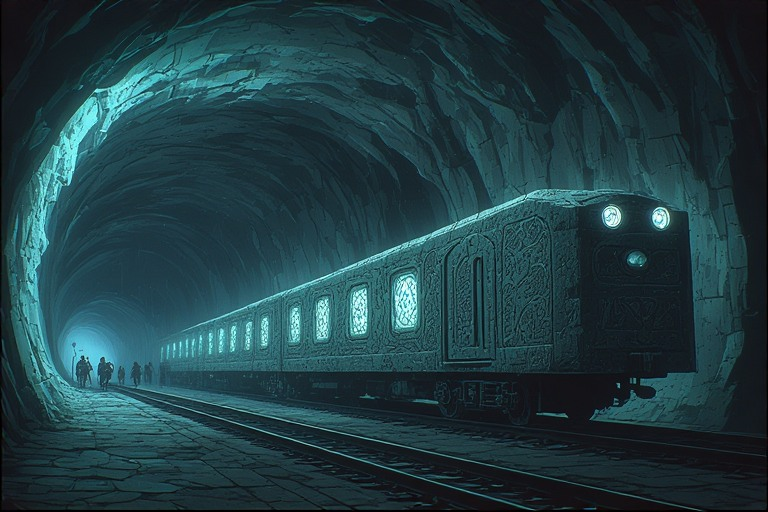
Visitors from outside Hodoronk tend to find the Deep Lines alarming the first time: the low rumble building under your feet before you see anything, then the rush of displaced air, then the carriage arriving at a speed that seems entirely wrong. Hodoronk dwarves find this reaction amusing. They board without breaking conversation.
The Golem-Bound
Mining collapses. Forge accidents. Giant raids on the outer posts. Battle wounds. In a city built on dangerous work and defended through constant vigilance, the loss of a limb is not uncommon.
Hodoronk's answer is the grafting rite — a Church of the Dwarfather procedure that replaces a lost limb with a crafted iron and stone prosthetic, animated through a ritual that bonds the new limb to the recipient's body and will. The result is not a tool strapped to a stump. It moves like flesh, responds like flesh, and in some cases exceeds flesh — a grafted arm can grip harder than a natural one, withstand heat that would blister skin, sustain force that would break bone.
The Golem-Bound — those who carry one or more grafts — are a common sight in Hodoronk. Single grafts are unremarkable. Those with two or three tend to be veterans or long-serving forge workers. The rare individuals who are half-iron or more — both arms, a leg, part of the torso — occupy a strange social position: deeply respected by those who understand what they've endured, occasionally unsettling to outsiders who have never seen a person whose left side moves like a machine.
The Church does not offer grafts casually. The rite requires significant recovery, a period of adjustment, and genuine acceptance of the change. It is considered a form of worship — the Dwarfather does not abandon those who serve him, and the graft is evidence of that.
Blessed Tools
The crafting tools used in Hodoronk's finest workshops are not ordinary equipment. Blessed Tools — Church-certified instruments enhanced through a combination of engineering and ritual — allow craftspeople to work in ways that would otherwise be physically impossible.
Common examples:
- Hearthblades — cutting tools whose edges are maintained at forge temperatures, allowing them to slice through materials that would shatter a cold chisel
- Force Hammers — striking tools that channel a burst of magical kinetic force on impact, hitting with the weight of something ten times their size
- True-Edge Gravers — engraving and finishing tools of impossible precision, guided partly by the crafter's intent rather than purely their hand
- Deep Lenses — inspection tools that allow craftspeople to see structural flaws, stress points, or impurities inside solid stone or metal
Blessed Tools are expensive, maintained by Church engineers, and guild-registered. Using a Blessed Tool without certification is a civil offense. Owning an uncertified one is a serious one.
Trade and Economy
Hodoronk is the inland hub of the League of Dwarven Trade Cities — the point where the coastal network's wealth meets the interior trade routes through the Krem Hills. Almost everything moving between the dwarven cities and the southern lands passes through here.
 Primary industries:
- **Stone and iron goods** — the city's foundational export. Hodoronk-made construction materials, tools, and hardware are considered the standard against which others are measured.
- **Engineering services** — the city exports expertise as much as product. Hodoronk engineers are hired across Ardentis to build walls, design drainage, plan fortifications.
- **River trade brokerage** — the city takes a cut of nearly everything moving along River Bonk, providing security, warehousing, and transit infrastructure in exchange.
- **Blessed Tool manufacture** — a significant Church-adjacent industry. Tools produced here are exported across the League and beyond.
Primary industries:
- **Stone and iron goods** — the city's foundational export. Hodoronk-made construction materials, tools, and hardware are considered the standard against which others are measured.
- **Engineering services** — the city exports expertise as much as product. Hodoronk engineers are hired across Ardentis to build walls, design drainage, plan fortifications.
- **River trade brokerage** — the city takes a cut of nearly everything moving along River Bonk, providing security, warehousing, and transit infrastructure in exchange.
- **Blessed Tool manufacture** — a significant Church-adjacent industry. Tools produced here are exported across the League and beyond.
The loss of the Deeprock trade routes in the late 3900s remains an open wound in Hodoronk's economic memory. Those routes never recovered. The city adapted, but the southern frontier is still considered unfinished business.
Governance
Hodoronk is governed by the Council of Guild Masters — representatives of the city's major guilds (Stone, Iron, River, Merchant, and Church) who meet weekly and make decisions by majority vote with the Church holding a standing veto on matters touching the Dwarfather's doctrine.
There is no single ruler. This is intentional. Dwarven political philosophy in Hodoronk holds that single rulers make single mistakes, and that distributed authority, while slower, produces more durable outcomes. Outsiders sometimes find the Council slow to act. Hodoronk's citizens find outsiders reckless.
The Garrison — a professional standing force of approximately 3,000 — reports to the Council but is overseen day-to-day by a Marshal appointed by the Iron Guild. The outer-ring forts are staffed by a rotating schedule of garrison units and guild volunteers.
Current State (4724–4725)
The Iceflame situation is the only thing anyone in the Council chambers wants to talk about. Coordination with Tronk is constant. The outer forts have been reinforced. The Deep Lines have been extended to allow faster movement of garrison forces to the river defenses.
The loss of Whitedove Harbor's northern trade capacity to Iceflame disruption has hit the merchant guild's revenues. There is tension on the Council between those who want to commit forces northward and those who argue that Hodoronk's value to the League is precisely that it does not fall.
The Church engineers have been running the Deep Lines on extended hours. The Golem-Bound veterans have been quiet. The statues of the Warrior aspect of the Dwarfather have fresh offerings at their bases every morning.
Connections
- Tronk — military satellite north of River Bonk
- Whitedove Harbor / Sandshore Harbor — League coastal partners
- Nordwall — south via the Established Road through the Krem Hills
- Deeprock — former southern trade partner, now ruins
- The Dwarfather — the city's spiritual and civic foundation